













RFIDとは? RFIDのしくみを解説 What is RFID

RFID Basics

RFIDってなにができるの?導入コストはどれくらい?

Basic InformationWhat RFID Can Do

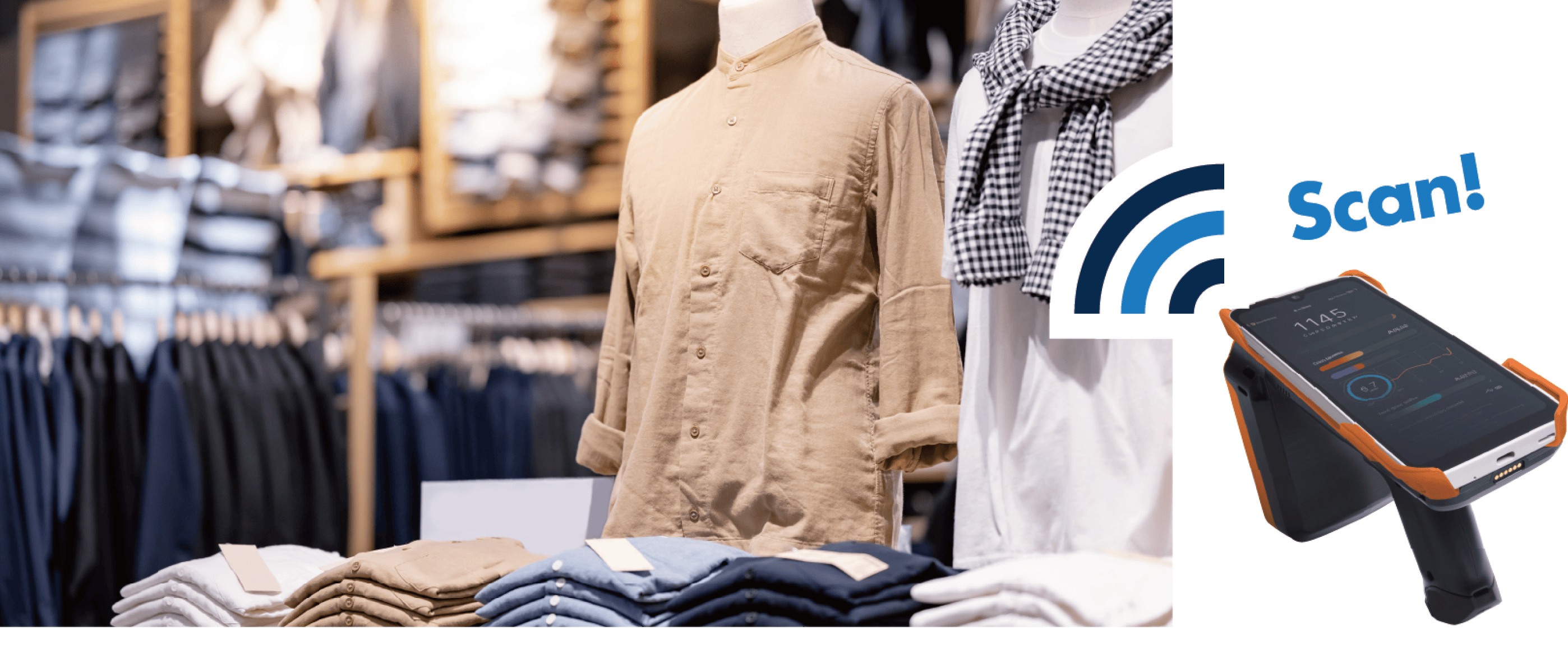
RFID can scan multiple items simultaneously and read them even at a distance. For example, in apparel store inventory management, traditional barcode scanning required scanning each item individually, but with RFID, items on shelves or still in boxes can be quickly read, significantly reducing work time. Additionally, it enables accurate checking, minimizing missed reads.

Major Industry Examples of RFID Implementation

現在準備中です。

Challenges Solved by RFID

  • Inventory
  • Product Search
  • Process Management
  • Receiving and Shipping Inspection
  • Accounting
  • Traceability
  • Picking
  • Theft Prevention
  • Authentication Management
  • Sorting
  • Asset Management

Solves diverse challenges across a wide range of industries

FeaturesRFID in Everyday Life

RFID, also known as “wireless automatic identification technology,” is a convenient technology deeply integrated into our daily lives. For example, it is used in various situations such as passing through ticket gates with transportation IC cards, shopping with electronic money, and product recognition at automated checkout registers. Since information can be read simply by holding a tag over a reader, no contact is required, enabling fast and hygienic transactions. In the future, RFID is expected to be utilized in even more fields such as smart home appliances, healthcare, and logistics, making life more comfortable and greatly contributing to the efficiency of society.

MechanismRFID Mechanism

RFID exchanges radio waves between RFID tags (IC tags/RF tags) and RFID readers to read information.
The IC tag receives radio waves transmitted from the reader’s antenna, and the IC chip embedded in the tag sends information back to the reader.
Product and inventory management can be performed in real time and quickly.
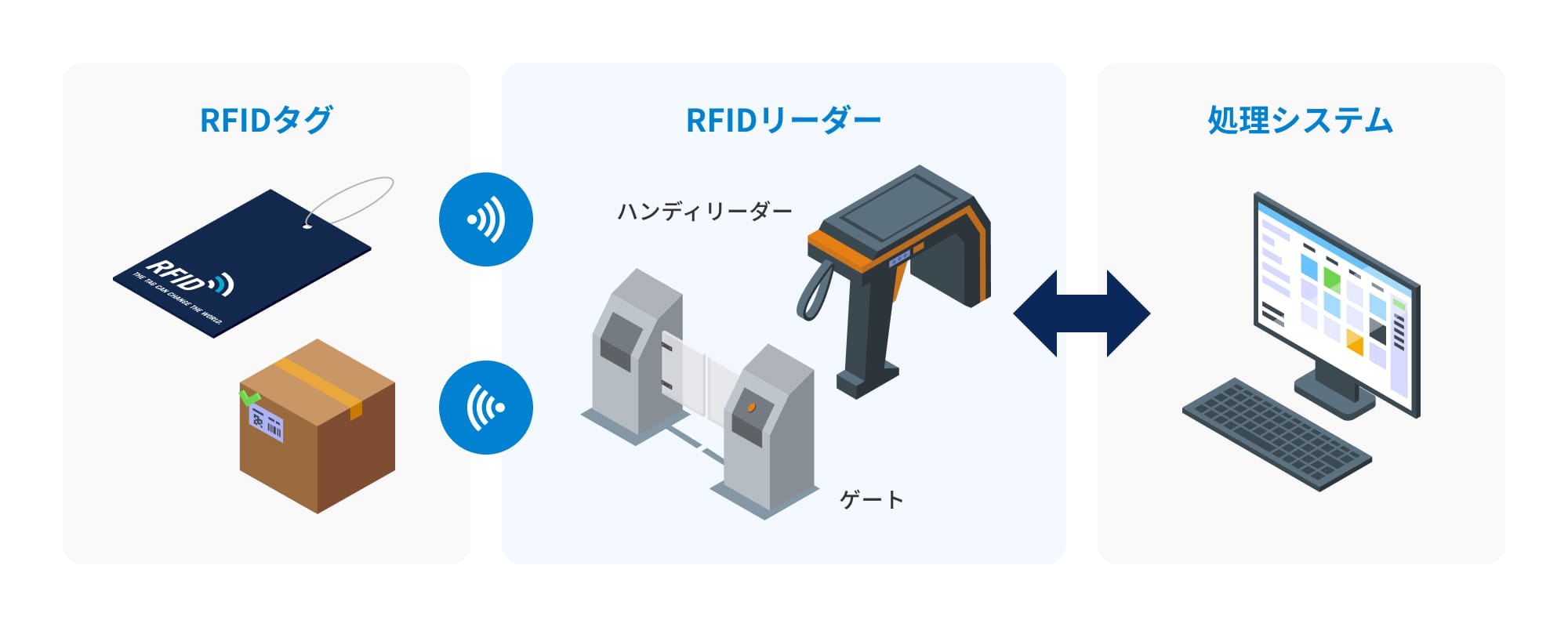
This mechanism enables easy and efficient inventory counting and inventory management through apps and systems.

Frequency BandsFrequency Differences

RFID has different characteristics and applications depending on the frequency band used.
In Japan, the following four frequency bands are utilized.
FrequencyCommunication MethodFeaturesCommunication DistanceApplications
LF BandElectromagnetic InductionResistant to EnvironmentApprox. 10 cmKeyless Entry
HF BandElectromagnetic InductionResistant to WaterApprox. 50 cmElectronic Money, Personal Authentication
UHF BandRadio Wave MethodLong Communication DistanceSeveral MetersLogistics, Inventory Management
Microwave BandRadio Wave MethodCompact AntennaApprox. 2 mVehicle Gate Passage

Advantages and DisadvantagesAdvantages and Disadvantages of RFID

TypeBarcodeRFID
Data Rewriting
  • Not Possible
  • Possible with Some Products
Simultaneous Reading
  • Not Possible
  • Possible *1
Reading Distance
  • Up to Several Tens of cm
  • Up to Several m
Impact of Obstructions and Dirt
  • Must Be Visible
  • Vulnerable to Dirt
  • Less Impact from Obstructions
  • Resistant to dirt
Cost
  • Lower Than RFID
  • Higher Than Barcode
*1 NFC does not support simultaneous reading.

Advantages

Wide reading range

Information can be acquired from a location several meters away, covering short to long distances.

Batch scanning of multiple items

Since multiple IC tags can be read at once, work efficiency is greatly improved.

Can be read while still in the box

Products can be read from the outside without taking them out of the box, saving working time.

Individual item management is possible

By assigning a serial number to the same SKU, individual item management can be performed for each item.

Resistant to dirt

Since reading is done by radio waves, reading failures due to dirt or blurring, as with barcodes, do not occur.

Disadvantages

Impact of Metal and Liquids

Standard RFID tags tend to have reduced reading accuracy due to the influence of metal and moisture. Tentac offers products that solve this problem.

Metal-Compatible Tags
Suitability for Laundry Environments

While standard RFID tags are generally unsuitable for laundry environments, we offer tags that combine durability (repeated washing, pressure dewatering, high-temperature drying, chemical detergents, ironing, etc.) and flexibility (soft material designed not to cause discomfort when sewn onto linen products).

Laundry Tags and Soft Linen Tags
Lack of Durability in Harsh Environments

While traditional RFID tags raise concerns about physical damage and insufficient environmental resistance, hard tags are protected by a robust exterior and can be used in outdoor, factory, logistics, and other environmental conditions.

Hard Tags

CostAbout Implementation Costs

Questions About RFID Implementation Pricing
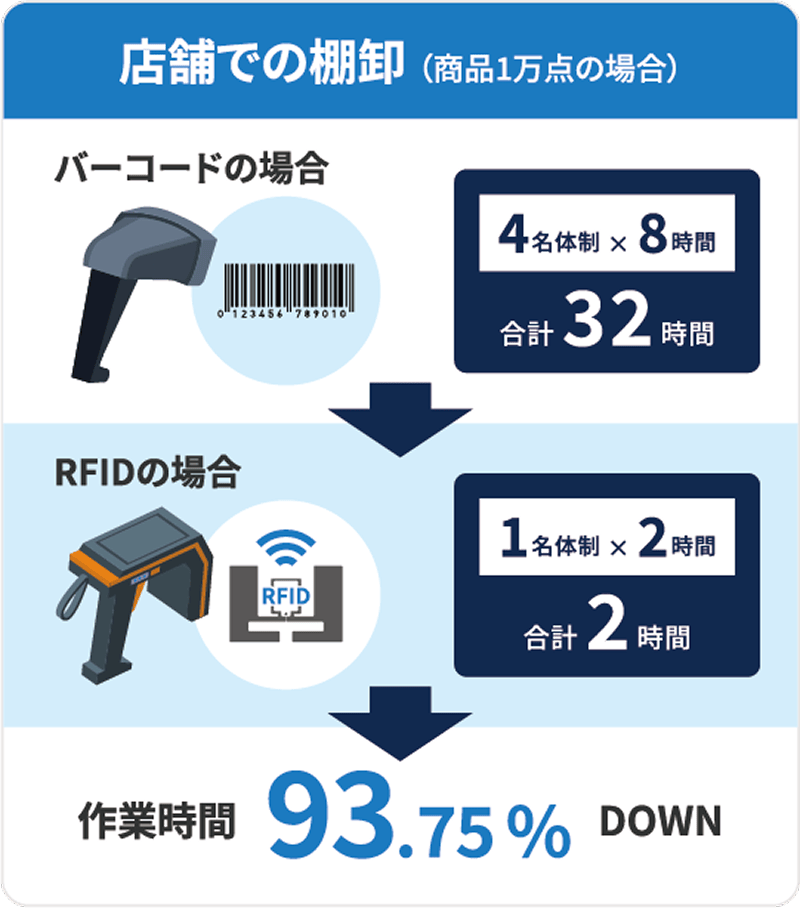
Let’s look at an example of streamlining inventory work at an apparel store.
Before implementing RFID, inventory work was performed by four staff members over eight hours. It was necessary to check each product tag individually, and checking products stacked on display shelves was particularly time-consuming.
After implementing RFID, the work was completed by one person in two hours. Closely spaced hangers and stacked products could be read smoothly by simply creating a small gap by hand, and tasks that had previously been a significant burden became dramatically more efficient.
In this way, utilizing RFID reduced work time by 93.75%, dramatically improving the efficiency of the entire inventory operation. While this technology requires an initial investment, continuous operation provides significant benefits through faster operations and improved accuracy.

CONTACT Contact Us